 English
 Español
  Português
  русский
  Français
  日本語
日本語  Deutsch
  tiếng Việt
  Italiano
  Nederlands

What Makes Folding Design Essential for Beach Trolley Portability?
A family arrives at the beach parking lot, the car packed with coolers, chairs, umbrellas, towels, and toys. The distance from the car to the water's edge is a quarter mile of soft sand. Without a beach trolley, this is a grueling multi-trip ordeal. With a beach trolley, it is a single, effortless journey. But here is the catch: the trolley itself must be transported to the beach. If it does not fold, it occupies valuable cargo space and is difficult to handle. This is where folding design becomes not just a convenience, but an essential feature. A non-folding beach trolley is a contradiction in terms; it defeats the very purpose of portability. The folding design is what transforms a bulky utility cart into a compact, transportable accessory that can be stored in a trunk, carried with one hand, and deployed in seconds.
The importance of folding design in beach trolleys extends beyond simple storage. It affects the weight of the trolley, the ease of deployment, the durability of the frame, and the overall user experience. A well-engineered folding mechanism must be robust enough to withstand the loads of beach gear, yet simple enough to be operated by a single person. It must be corrosion-resistant to survive the salt air and sand. And it must be designed to fold into a compact package that fits into the trunk of a car or the back of an SUV. At Ningbo Marine Outdoor Products Co., Ltd., our factory has been designing and manufacturing folding beach trolleys for over a decade, and we have refined the art and science of folding design to deliver products that are both portable and durable. This article will explore the engineering principles behind folding beach trolleys, the types of folding mechanisms, the materials that make them work, and the performance characteristics that define a high-quality product.
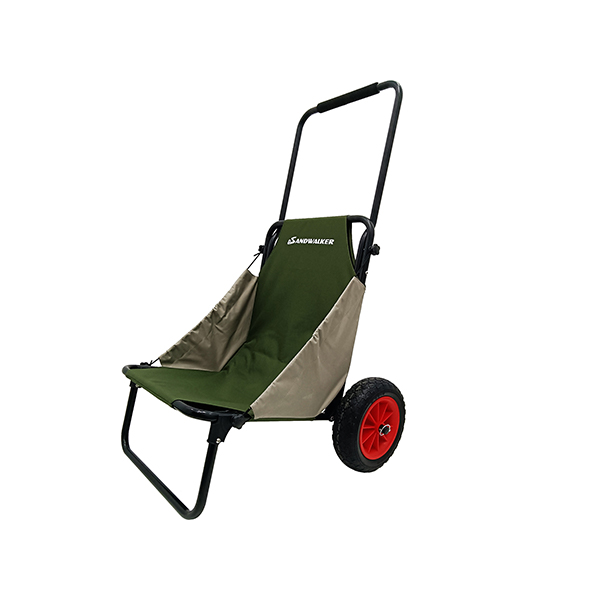
Table of Contents
- 1. What Is a Folding Beach Trolley and Why Does Folding Matter?
- 2. What Folding Mechanisms Are Used and How Do They Compare?
- 3. How Does Frame Material Affect Folding Performance and Durability?
- 4. What Role Does Wheel Design Play in Portability and Folding?
- 5. How Does Folding Design Impact Load Capacity and Stability?
- 6. Frequently Asked Questions (FAQ)
- 7. Conclusion
1. What Is a Folding Beach Trolley and Why Does Folding Matter?
A folding beach trolley, also known as a beach cart or beach wagon, is a wheeled cart designed to transport beach equipment over sand and other uneven surfaces. The defining feature of a folding beach trolley is its ability to collapse into a compact form for storage and transport. This is achieved through a system of hinges, pivots, and locking mechanisms that allow the frame to fold down. When unfolded, the trolley provides a stable platform for carrying gear. When folded, it becomes a compact package that can be easily lifted and stored. The folding design is not an add-on feature; it is the core of the product's portability.
Without a folding design, a beach trolley would be a rigid, bulky object that is difficult to transport and store. It would occupy a significant amount of space in a vehicle and would be cumbersome to carry when not in use. The folding design solves these problems by allowing the trolley to be reduced in size by 50-70% of its unfolded dimensions. This compact size makes it practical to keep a beach trolley in the car at all times, ready for spontaneous beach trips. It also makes it possible to store the trolley in a closet, garage, or shed without taking up valuable space.
The folding design also contributes to the user experience in other ways. A well-designed folding mechanism allows the trolley to be deployed quickly and easily, often with a single motion. This is important when you are eager to get to the beach. It also allows the trolley to be folded with one hand, which is convenient when you are holding other items. The folding design can also enhance the durability of the trolley by allowing it to be stored in a protected environment when not in use, reducing exposure to the elements. At Ningbo Marine Outdoor Products Co., Ltd., we have designed our folding beach trolleys to be exceptionally easy to use, with intuitive folding mechanisms that require minimal effort.
2. What Folding Mechanisms Are Used and How Do They Compare?
The folding mechanism is the heart of a folding beach trolley. It is the system of hinges, pivots, and locks that allows the trolley to collapse and expand. There are several different types of folding mechanisms, each with its own set of advantages and disadvantages. The choice of mechanism affects the ease of use, the durability, and the cost of the trolley. The most common types are the X-frame mechanism, the scissor mechanism, and the telescoping mechanism. Each type has a different folding pattern and different performance characteristics.
X-Frame Mechanism: The X-frame mechanism is the most common type of folding mechanism for beach trolleys. It consists of two X-shaped frames that are connected by a pivot. When the trolley is unfolded, the X-frames are locked in an open position, providing a stable platform. When the trolley is folded, the X-frames collapse inward, reducing the trolley's footprint. The X-frame mechanism is simple, robust, and relatively inexpensive. It is easy to operate and can be folded with a single motion. However, the X-frame mechanism can be less stable than other types when fully loaded, as the pivot points can develop play over time. The following table compares the key characteristics of the X-frame mechanism with other common mechanisms.
| Mechanism Type | Folding Pattern | Ease of Use | Stability | Durability | Cost |
| X-Frame | Scissor-like collapse | Very Easy | Good | Good | Low |
| Scissor | Concertina collapse | Easy | Very Good | Very Good | Medium |
| Telescoping | Sliding tubes | Easy | Excellent | Excellent | High |
Scissor Mechanism: The scissor mechanism, also known as a concertina mechanism, uses a series of linked bars that fold in a zigzag pattern. This mechanism is more complex than the X-frame but provides greater stability and durability. The scissor mechanism distributes the load more evenly across the frame, reducing stress on individual pivot points. It is often used in higher-end beach trolleys.
Telescoping Mechanism: The telescoping mechanism uses sliding tubes that extend and retract. This is the most stable and durable type of folding mechanism, but it is also the most expensive and the most complex to manufacture. Telescoping mechanisms are often used in heavy-duty beach trolleys designed for carrying large loads. At Ningbo Marine Outdoor Products Co., Ltd., we offer beach trolleys with all three types of mechanisms, allowing our customers to choose the one that best fits their needs and budget.
3. How Does Frame Material Affect Folding Performance and Durability?
The frame material is a critical factor in the performance and durability of a folding beach trolley. The frame must be strong enough to support the load, light enough to be easily transported, and corrosion-resistant to survive the salt air and sand of the beach environment. The three most common frame materials are aluminum, steel, and engineering plastics. Each material has its own set of properties and trade-offs. The choice of material affects the weight of the trolley, its load capacity, its durability, and its cost. At our factory, we have extensive experience in working with all these materials and can help you select the right one for your application.
Aluminum: Aluminum is the most popular material for beach trolley frames. It is lightweight, strong, and naturally corrosion-resistant. Aluminum frames are typically made from 6061 or 7075 alloy, which offer an excellent strength-to-weight ratio. An aluminum frame can be anodized or powder-coated to further improve its corrosion resistance and appearance. The main disadvantage of aluminum is its cost, which is higher than steel. However, the weight savings and durability often justify the higher price.
Steel: Steel is stronger and less expensive than aluminum, but it is also heavier and prone to rust. Steel frames are typically made from carbon steel and are powder-coated to protect against corrosion. However, if the coating is scratched, the steel underneath can rust. Stainless steel is an alternative that offers excellent corrosion resistance, but it is more expensive and heavier than aluminum. For beach trolleys, aluminum is generally the preferred material.
Engineering Plastics: Some beach trolleys use engineering plastics, such as polypropylene or nylon, for the frame or components. These materials are lightweight, corrosion-resistant, and inexpensive. However, they are not as strong as metal and may not be suitable for heavy loads. They are often used in budget-friendly or lightweight trolleys. The table below provides a comparison of the key properties of these frame materials.
| Material | Weight | Strength | Corrosion Resistance | Cost | Typical Application |
| Aluminum (6061) | Light | High | Excellent | Medium-High | Standard to premium beach trolleys |
| Carbon Steel | Heavy | Very High | Poor (requires coating) | Low | Budget-friendly trolleys |
| Stainless Steel | Heavy | Very High | Excellent | High | Premium, heavy-duty trolleys |
| Engineering Plastics | Very Light | Moderate | Excellent | Low | Lightweight, compact trolleys |
The frame material also affects the folding mechanism. Aluminum frames are easier to drill and machine, which allows for more precise hinge and pivot points. Steel frames are more difficult to machine but are stronger, which can be an advantage for heavy-duty applications. At Ningbo Marine Outdoor Products Co., Ltd., we primarily use aluminum for our beach trolley frames because of its excellent balance of weight, strength, and corrosion resistance. We also offer stainless steel options for customers who require maximum durability.
4. What Role Does Wheel Design Play in Portability and Folding?
The wheels are a critical component of a beach trolley, and their design has a significant impact on both portability and folding. The wheels must be large enough to roll over soft sand, yet small enough to allow the trolley to fold compactly. They must be wide enough to provide flotation, yet not so wide that they become difficult to store. They must be durable enough to withstand the abrasive action of sand and salt water, yet light enough to not add excessive weight. The design of the wheels and their attachment to the frame is a key consideration in the overall portability of the trolley.
The most common type of wheel for beach trolleys is the balloon wheel. Balloon wheels are wide, low-pressure tires that provide excellent flotation on soft sand. They are typically 20-30 cm in diameter and 10-15 cm wide. They roll easily over sand and other uneven surfaces, reducing the effort required to pull the trolley. However, balloon wheels are bulkier than standard wheels and can be more difficult to fold. Some folding beach trolleys use detachable wheels, which can be removed and stored separately when the trolley is folded. This allows for a more compact folded size.
Other wheel types include standard pneumatic wheels, solid rubber wheels, and plastic wheels. Standard pneumatic wheels are narrower than balloon wheels and are better suited for hard surfaces. Solid rubber wheels are puncture-proof and durable but are heavier than pneumatic wheels. Plastic wheels are lightweight and inexpensive but are not as durable. The table below compares the different wheel types for beach trolleys.
| Wheel Type | Diameter (cm) | Width (cm) | Sand Performance | Folding Impact | Typical Use |
| Balloon Wheel | 20-30 | 10-15 | Excellent | Requires space | Soft sand, heavy loads |
| Standard Pneumatic | 15-25 | 5-8 | Good | Moderate | Mixed surfaces |
| Solid Rubber | 15-20 | 5-8 | Fair | Low | Hard surfaces |
| Plastic | 10-15 | 3-5 | Poor | Very Low | Light loads, hard surfaces |
At Ningbo Marine Outdoor Products Co., Ltd., we offer beach trolleys with a range of wheel options. Our most popular models feature balloon wheels for superior performance on sand. We also offer models with detachable wheels for improved folding compactness. Our factory can also customize the wheel type and size to meet the specific requirements of our customers.
5. How Does Folding Design Impact Load Capacity and Stability?
There is an inherent trade-off between folding compactness and load capacity. A trolley that folds very small may not be as strong or as stable as a trolley that folds into a larger package. The folding mechanism and the frame design must be engineered to provide an optimal balance between these two competing requirements. A folding beach trolley must be able to carry a significant load of beach gear without becoming unstable or collapsing. The load capacity is determined by the strength of the frame, the design of the hinges and pivots, and the stability of the wheelbase. The stability is determined by the width of the wheelbase and the height of the load platform.
When a beach trolley is loaded, the weight of the gear creates forces that are transmitted through the frame and the folding mechanism. The hinges and pivots must be strong enough to withstand these forces without deforming or breaking. The locking mechanisms must be secure enough to prevent the trolley from accidentally folding while in use. This is a critical safety consideration. A trolley that folds unexpectedly under load can cause injury and damage to the contents. At our factory, we test our folding mechanisms under load to ensure that they are secure and reliable. We use high-strength steel pins and reinforced hinges to provide maximum strength and durability.
The wheelbase also affects stability. A wider wheelbase provides greater lateral stability, reducing the risk of the trolley tipping over. However, a wider wheelbase may also make the trolley more difficult to fold into a compact package. The height of the load platform affects the center of gravity. A lower platform provides greater stability, but it may reduce ground clearance. The design of the trolley must balance these factors to achieve the optimal combination of stability and folding compactness. The table below shows the relationship between folding design, load capacity, and stability.
| Design Factor | Impact on Load Capacity | Impact on Stability | Impact on Folding Compactness |
| Frame Material (Aluminum) | High | High | Good |
| Hinge Design (Reinforced) | High | High | Moderate |
| Wheelbase Width | Moderate | High | Low (wider = less compact) |
| Platform Height | Low | High (lower = more stable) | Moderate |
| Locking Mechanism | High | High | Low |
At Ningbo Marine Outdoor Products Co., Ltd., we have optimized our folding beach trolleys to provide an excellent balance of load capacity, stability, and folding compactness. Our trolleys can carry loads of up to 100 kg while folding into a compact package that fits easily into the trunk of a car. We achieve this through a combination of high-strength materials, precision engineering, and rigorous testing.
6. Frequently Asked Questions (FAQ)
Question 1: How small does a folding beach trolley fold?
Answer: The folded size of a beach trolley depends on the model and the folding mechanism. Typically, a folding beach trolley folds to approximately 50-70% of its unfolded dimensions. For example, a trolley that is 100 cm long and 50 cm wide when unfolded may fold to 60 cm long and 40 cm wide. The folded depth is usually 20-30 cm. At Ningbo Marine Outdoor Products Co., Ltd., we provide detailed folded dimensions for each of our models.
Question 2: Can a folding beach trolley be folded with one hand?
Answer: Many modern folding beach trolleys are designed to be folded with one hand. The mechanism typically involves a simple release lever or button that unlocks the frame, allowing it to collapse. Some models feature a "one-touch" folding system that requires only a single motion. Our factory designs our trolleys with user-friendly folding mechanisms that can be operated with minimal effort.
Question 3: How much weight can a folding beach trolley hold?
Answer: The load capacity of a folding beach trolley varies by model. Lightweight models may hold 30-50 kg, while heavy-duty models can hold 80-100 kg or more. The load capacity is determined by the strength of the frame, the hinges, and the wheels. At our factory, we test our trolleys to ensure they meet their rated load capacity. We recommend selecting a trolley with a load capacity that exceeds your expected load by at least 20% for safety and durability.
Question 4: Are folding beach trolleys easy to push on sand?
Answer: Yes, folding beach trolleys are designed to be easy to push on sand, provided they are equipped with the right wheels. Balloon wheels are the best choice for soft sand, as they provide flotation and reduce rolling resistance. Standard pneumatic wheels are also suitable for firm sand. Solid rubber or plastic wheels are not recommended for soft sand. Our beach trolleys are available with balloon wheels for optimal sand performance.
Question 5: What is the best material for a folding beach trolley frame?
Answer: Aluminum is the best material for a folding beach trolley frame. It is lightweight, strong, and naturally corrosion-resistant. Aluminum frames are easy to fold and unfold, and they can be anodized or powder-coated for additional protection. Stainless steel is an alternative for heavy-duty applications, but it is heavier and more expensive. At Ningbo Marine Outdoor Products Co., Ltd., we primarily use aluminum for our beach trolley frames.
7. Conclusion
Folding design is not a luxury for beach trolleys; it is an essential feature that defines their portability and practicality. The ability to fold the trolley into a compact package for storage and transport is what makes a beach trolley a viable solution for beachgoers. A well-engineered folding mechanism must be robust, easy to use, and secure under load. The frame material must be lightweight, strong, and corrosion-resistant. The wheels must be designed for sand performance and folding compactness. And the overall design must balance load capacity, stability, and folded size. At Ningbo Marine Outdoor Products Co., Ltd., our factory has the expertise and experience to design and manufacture folding beach trolleys that meet the highest standards of performance and reliability. We use advanced materials, precision engineering, and rigorous testing to ensure that every trolley we produce delivers the portability and durability that our customers expect.
Whether you are a casual beachgoer or a serious outdoor enthusiast, a folding beach trolley from Ningbo Marine Outdoor Products Co., Ltd. is the perfect solution for transporting your gear. We offer a range of models with different folding mechanisms, frame materials, and wheel options to suit every need. Our technical team is available to help you select the right trolley for your specific requirements.
Contact Ningbo Marine Outdoor Products Co., Ltd. today to learn more about our folding beach trolleys and how they can enhance your beach experience.
Previous:No News
Send Inquiry



X
We use cookies to offer you a better browsing experience, analyze site traffic and personalize content. By using this site, you agree to our use of cookies.
Privacy Policy